Section outline
-
-
Due: Monday, 9 June 2025, 8:39 AM
This forum is not for questions about homework or activities. It is to ask questions about how to interact with the platform. Thanks!
-
-
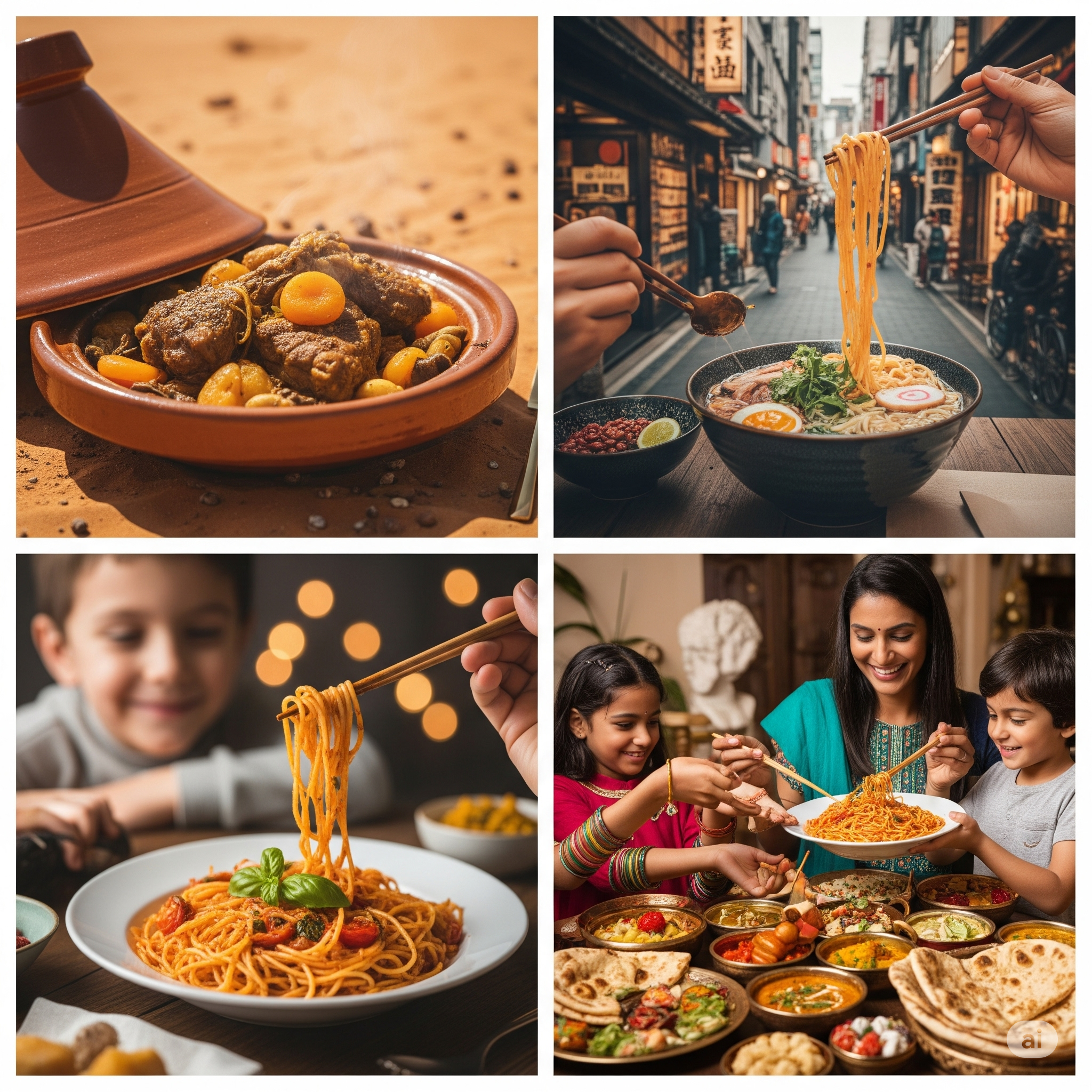
Hi, welcome to this module.
The objectives of this module are:
-Identification of the importance of food in everyday context.
-Identification of some common food in our everyday life.
- Model + practice: Description of what we eat for breakfast, lunch and dinner in given a context.
-Wrap up activity: Describe your meal in a given context.
-
Objective: Practice key vocabulary in context related to food, so you can use it later to describe your own and other people's meals.
Look for difficult words in a DICTIONARY

-
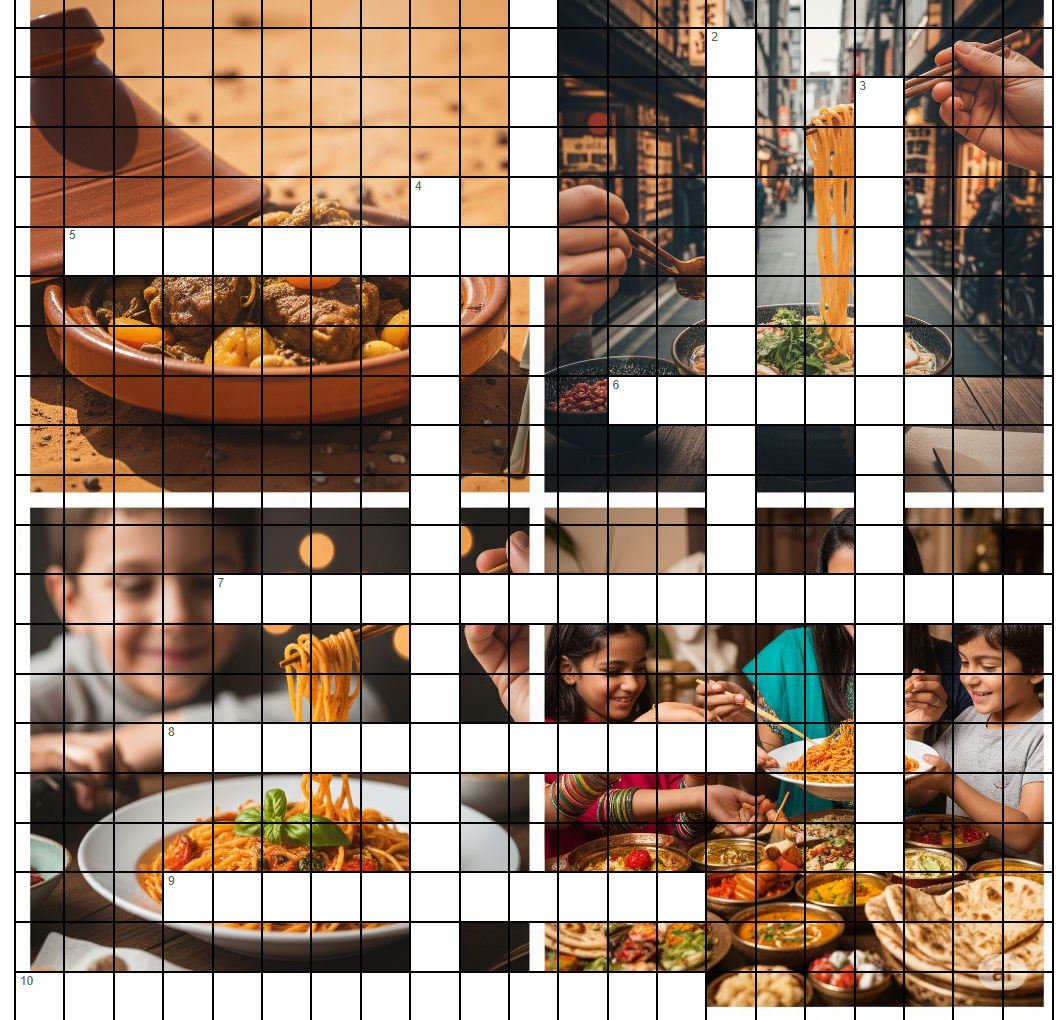
PR+A Practice Vocabulary from the Menus H5P
Do the activity until you have 100% of correct answers.
Less than 100% will be considered not finished (this means no attendance)
-
-
-
PR + A. 9A. Session 6. Quantifiers with Countable Nouns H5P
-
EV. 9A. Session 6. Quantifiers for Countable nouns. H5P
Listening and typing activity for evaluation.
You can do THIS activity either on Monday or Tuesday, before June 18th.
-
WR. 9A. Countable Foods and Their Global Culture H5P
Wrap up activity (also for evaluation).
You can do THIS activity either on Monday or Tuesday, before June 18th.
-
-
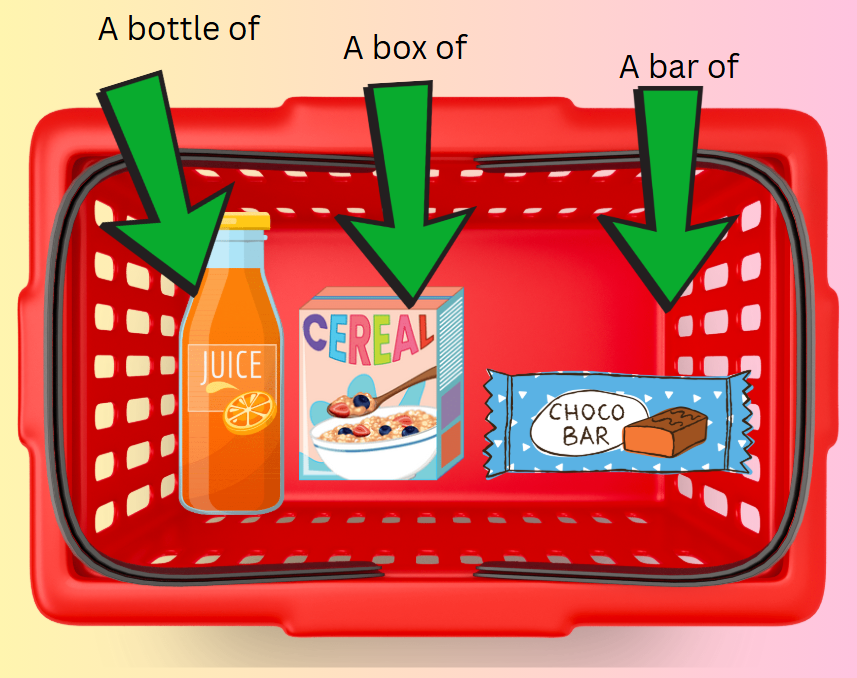
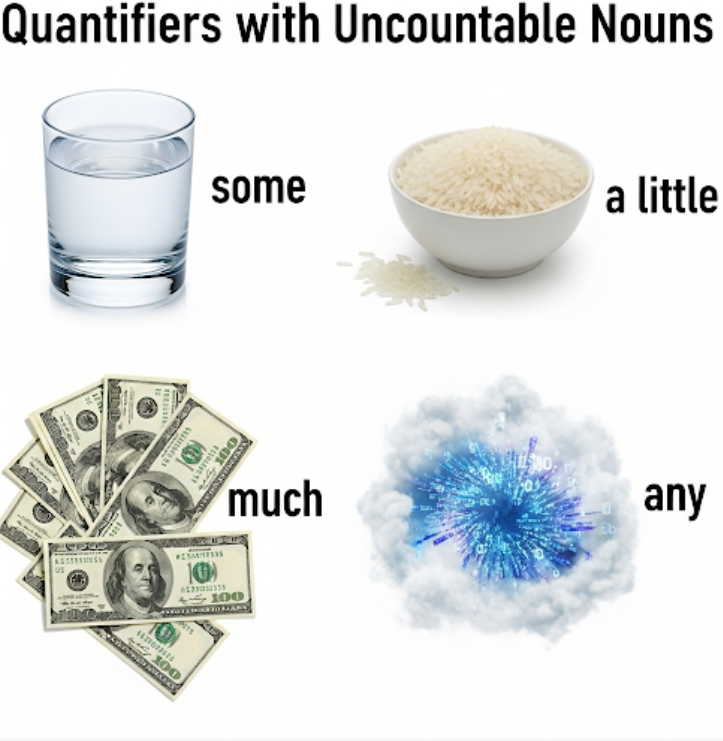
What are Quantifiers? (For Uncountable Nouns)
Imagine you want to talk about "water" or "money." You can't say "one water" or "two moneys" like you say "one apple" or "two apples."
Why? Because water and money are "uncountable nouns." They don't have a plural form. We can't count them as single items.
We count money, but we can't pluralize the NOUN "money". You can't say "one money, two moneys". that's why the NOUN money is not countable.
So, to talk about the amount of these things, we use special words called Quantifiers.
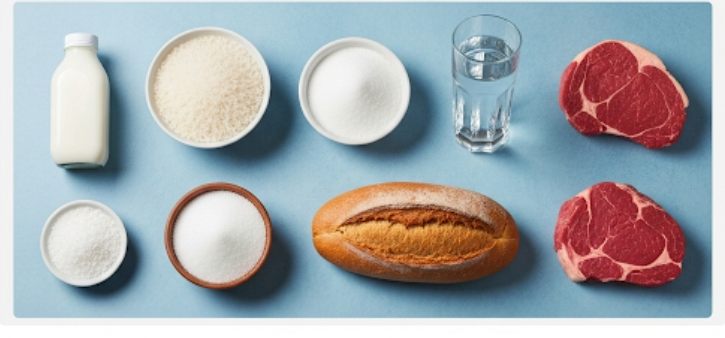
Uncountable Food List
Here's a list of common food items that we typically consider uncountable, meaning we don't usually say "one oil" or "two breads."
-
Rice: 🍚
-
Sugar: ⬜⬜⬜ (Think of loose sugar grains)
-
Salt: 🧂
-
Flour: ☁️ (Like a cloud of powder)
-
Bread: 🍞
-
Pasta: 🍝
-
Meat: 🥩
-
Chicken: 🍗
-
Fish: 🐟
-
Cheese: 🧀
-
Milk: 🥛
-
Water: 💧
-
Juice: 🍹
-
Coffee: ☕
-
Tea: 🍵
-
Oil: 🍾 (A bottle, representing liquid oil)
-
Butter: 🧈
-
Jam: 🍓
-
Honey: 🍯
-
Soup: 🥣
-
-
PR+A. Food Orders: Count or Uncount? H5P
Learning goal: Students will be able to correctly identify and use appropriate quantifiers or phrases with common uncountable food nouns.
This activity is NOT for evaluation. Please, attempt it FOR THE FIRST TIME the day of your session FOR ATTENDANCE.
For only Practice, the activity will be available until June 19, 23:59 p.m.
-
EV. 9A. Session 7. Restaurant Order: What's Correct? H5P
This activity uses multiple-choice questions to test understanding of quantifiers in context.
This activity is for evaluation. You have before June 20 to do it.
-
WR. 9A. Session 7. Restaurant Order: True or False? H5PThis activity is for evaluation.
You have before June 20 to do it.
-
-
Due: Tuesday, 24 June 2025, 11:59 PM
This activity is for practice and attendance. Follow the instructions carefully for attendance. This is NOT for evaluation. Please, do the activity the day of your session to count as attendance.
Write a short description in form of a list of what you usually have for breakfast, lunch and dinner. Use quantifiers, quantities and containers, when necessary. Follow the example. Then comment on 2 other partner's posts: are they eating healthily or unhealthily?
For breakfast I usually have:
2 eggs (fried in cheap oil).
½ cup (120ml) of refried beans (leftover from a big batch cooked earlier in the week).
4 corn tortillas (homemade or bought by the kilo for ~$10 MXN).
2 tbsp (30ml) of homemade salsa (blended tomatoes and chili).
1 cup (240ml) of café de olla (sweetened coffee) or 1 glass (300ml) of agua de jamaica (hibiscus tea)
2 cups (200g) of spaghetti or noodles (bulk-bought, cheapest brand).
½ can (80g) of tuna (shared between two meals to save money).
½ cup (60g) of mixed veggies (carrot, onion, tomato—whatever’s on sale).
3 tortillas (essential filler).
1 glass (300ml) of homemade lemonade (water, sugar, lime) or 250ml of Coke (from a returned-glass bottle for discount).
2 bolillo rolls (or 3 small tortillas) with ¼ cup (60g) mashed beans.
1 oz (30g) of Oaxaca cheese for quesadillas.
Chili powder or hot sauce (to add flavor).
1 cup (240ml) of chamomile tea or milk with a splash of coffee.
-
WR. Module 9B. Session 9. Shopping for Groceries H5P
-
-
In this module we are going to learn how to write a paragraph.
How to Write a Paragraph
A good paragraph has three key parts:
Topic Sentence (the main idea).
Supporting Details (examples, facts, or descriptions).
Concluding Sentence (summary or link to the next idea).

Key Tips:
Topic Sentence: Start clear and simple.
Supporting Details: Add 2-3 examples or facts.
Concluding Sentence: Close the idea or hint at what’s next.
-
PR+A. 9B. Session 10. Writing. Sort the sentences H5P
This activity is for attendance. Please, do it to get 100% of correct answers.
Do the activity the day of your session to be considered as attendance.

-
EV. Session 10. Module 9C. H5P
To compare places we use comparative expressions.
Key Grammar:
Short adjectives: Add -er (cheap → cheaper, big → bigger).
Long adjectives: Use more + adjective (more organized, more exciting).
Irregular: good → better, bad → worse.
Example Practice:
"A castle is ______ (old) than a theater. A market is ______ (noisy) than a department store!"
(Answers: older, noisier) -
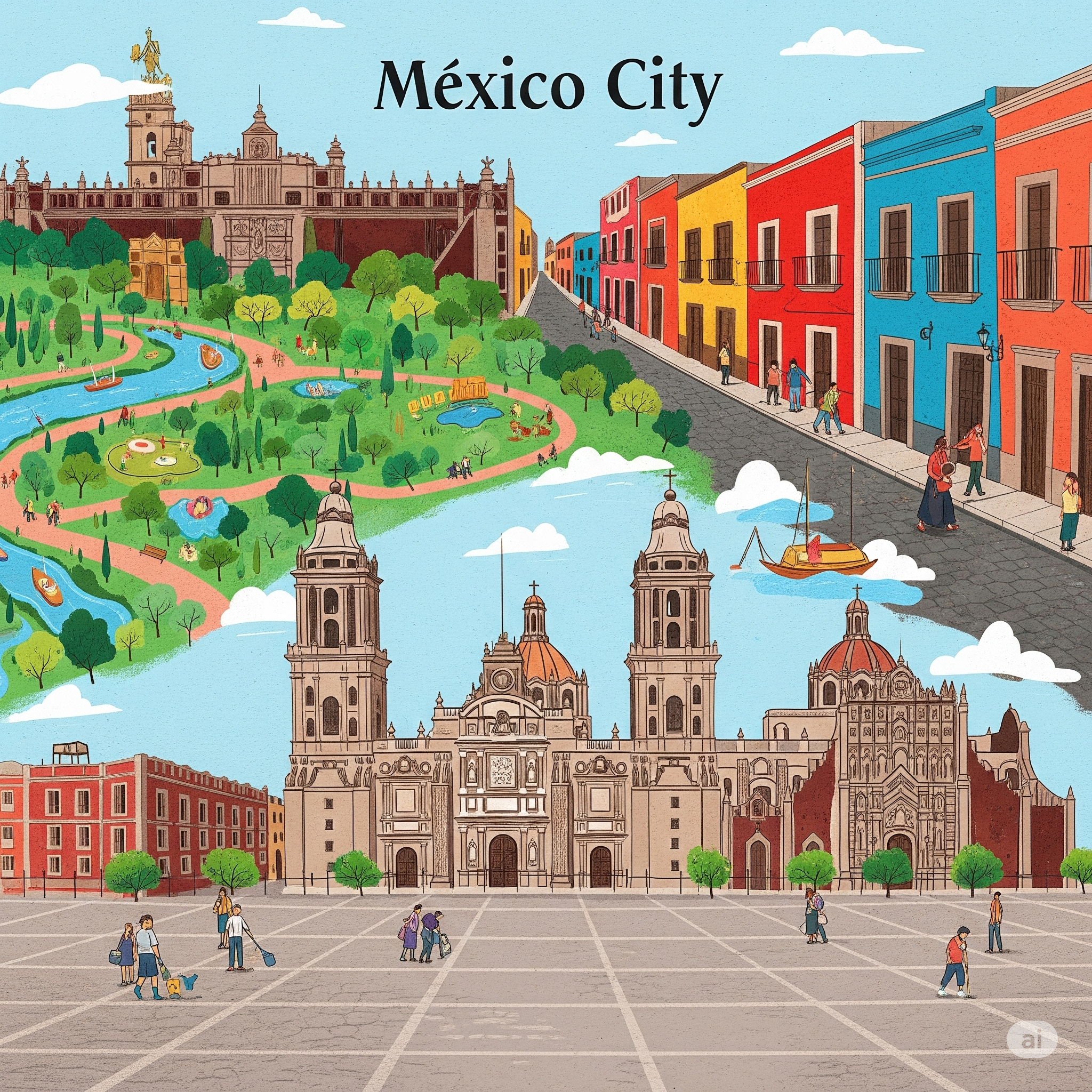
WR. Module 9C. Comparing Buildings in Mexico City H5P
To compare buildings, you need special adjectival forms and structures.
Short adjectives (1-2 syllables): Add -er
→ tall → taller, old → older, big → biggerLong adjectives (3+ syllables): Use more + adjective
→ modern → more modern, beautiful → more beautifulIrregular:
→ good → better, bad → worse, far → fartherUse THAN (not then) to compare 2 elements. For example :"The cathedral is older than the skyscraper. "Markets are more crowded than malls."
-
-
-

The last boy is the tallest of the three!
A Short Guide to Using Superlative Adjectives
Superlative form of adjectives are useful to compare three or more things to show the highest or lowest degree of a quality.
Forming Superlatives
One-syllable: Add -est.
Examples: tall tallest 🦒, short shortest 🩱.
Rule: Double final consonant if single vowel + single consonant (e.g., big biggest 🐘).
Two-syllable ending in -y: Change -y to -i, then add -est.
Examples: happy happiest 😄, easy easiest ✅.
Two+ syllables (not ending in -y): Use "most" before the adjective.
Examples: beautiful most beautiful 🌸, expensive most expensive 💎.
Irregular: Memorize!
Examples: good best ⭐, bad worst 🗑️, far farthest/furthest 🚀.
Using Superlatives in Sentences
Always use "the" before the superlative.
Structure: Noun + verb + the + superlative adjective + (of/in a group).
Examples:
Mount Everest is the tallest mountain in the world. ⛰️
This is the most interesting book I've ever read. 📖
Avoid These Mistakes
No "most" with -est endings (e.g., not "most happiest").
Always include "the".
-
EV. Session 12. Modules 9C & 10A. Speak Comparative and Superlative H5P
-
WR. Modules 9C & 10A. Session 12. H5P
Wrap up Activity! This counts for evaluation.
-
-
-
-
PR+A. Module 10B. Session 13. Planning a Trip. H5P
You need 100% of correct answers for attendance.
Do you want to talk about your future plans? Things you decided to do? We use "BE GOING TO"!
1. What does it mean?
It means you have a plan for the future. You already decided it.
Example: Tomorrow, I am going to visit my grandmother. (It's my plan!)
2. How to make it (the form):
We use: Subject + BE (am/is/are) + GOING TO + Base Verb
3. When do we use "BE GOING TO"?
We use it for PLANS or INTENTIONS. Things you have decided to do in the future.
Example: My sister is going to start a new job next week. (She has a plan.)
Example: We are going to have a party on Saturday. (It's our plan.)
4. Making it negative:
To say "no plan," put NOT after BE (am/is/are).
Subject + BE (am/is/are) + NOT + GOING TO + Base Verb
5. Making questions:
To ask about plans, change the order: BE (am/is/are) + Subject + GOING TO + Base Verb?
BE (am/is/are) + Subject + GOING TO + Base Verb?
Remember: "Be going to" is for plans you've already made!
-
Grammar Guide: Talking about Predictions with "BE GOING TO"
We learned "BE GOING TO" for plans (things you decided). But we also use it for predictions!
1. What does it mean for predictions?
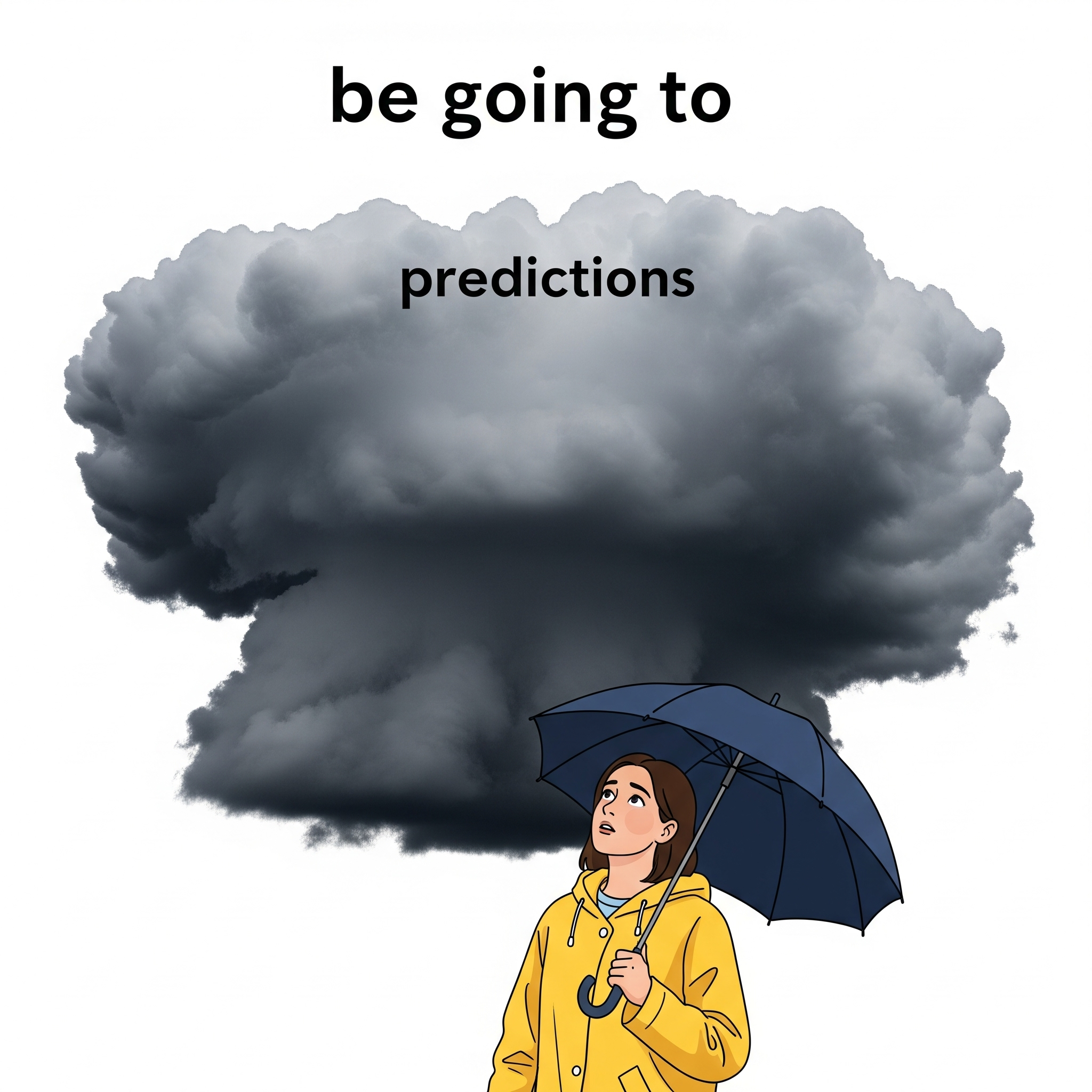
It means you think something will happen in the future because you see or hear something NOW. You have evidence.
Example: Look at those dark clouds! It is going to rain. (You see the clouds = evidence)
2. The form (It's the same!):
We use: Subject + BE (am/is/are) + GOING TO + Base Verb
3. When do we use "BE GOING TO" for predictions?
We use it when you see or hear something now that tells you what will happen. It's not just a guess!
Evidence: Look! The sky is very dark.
Prediction: It is going to rain.
Evidence: Oh no! That car is driving very fast.
Prediction: It is going to crash!
Evidence: The baby looks tired and sleepy.
Prediction: She is going to sleep soon.
4. Important Difference (Plans vs. Predictions):
Plan: "I am going to study tonight." (My decision.)
Prediction: "The exam is going to be difficult." (I think so, based on what I know.)
Remember: For predictions, look for the evidence now!
-
Ev. Module 10B. Session 13. Our World Today H5P
-
-
-
-
MTE. PART 5. LISTENING H5P
Listen to the audio, read the question and choose the best answer. You CANNOT GO BACK TO PREVIOUS QUESTIONS, so listen carefully and answer each question. You can try ONLY ONCE (only one time) the test. Safe Exam Browser is NOT needed for this one. Visualization of attempts was disabled for this test.
-
MTE. PART 6. SPEAKING H5PRead the text aloud and practice pronunciation and fluency before trying the test. You can do the test several times, before July 11. You can see your attempts as usual. Highest grade is taken into account. Safe Exam Browser is not needed for this one.Question 1. Using clean energy is going to increase a lot. Countries are going to build more solar panels and wind farms. This is going to help the Earth. We are going to use less oil and gas. Companies are going to invest more money in renewable energy.*NOTE: wind is pronunciated as /uínd/ not /uáind/Question 2. This change is going to make our air cleaner. It is also going to help stop climate change. Our planet is going to be healthier in the future. It's a very important environmental step.
-
-
-
PR+A. Module 10C. Session 13. Plans vs Prediction with evidence H5P
This activity is for Attendance. Do it several times until you get 100% of correct answers. Don't forget to very your attempt.
Identify the difference between a plan and a prediction based on evidence.
-
EV. Module 11A. Session 16. Paragraphing H5P
-
WR. Module 11A. Culture Shock: Navigating Global Differences H5P
-
This activity is NOT for Evaluation.
Read the text as you listen. Identify difficult words for you, and find their meaning in a dictionary.
Moving abroad means encountering customs that operate differently, abruptly, or even unthinkably from home. Here’s how everyday situations vary drastically across four countries:
💼 Salary Discussions
In Japan, employees rarely discuss salaries openly; inquiries are made indirectly to avoid seeming boastful.
In the Netherlands, colleagues share pay details transparently—asking "Hoeveel verdien je?" ("How much do you earn?") is perfectly normal.
🍜 Food Customs
In India, hosts serve spice-heavy curries generously, expecting guests to eat enthusiastically with their hands. Refusing seconds is politely declined.
In Finland, meals are eaten quietly; talking while chewing is firmly discouraged. Reaching across the table is considered extremely rude.
👔 Addressing People
In South Korea, juniors bow deeply to seniors and use titles respectfully (e.g., "Kim seonsaengnim" for "Teacher Kim"). First names are strictly avoided.
In Australia, coworkers greet bosses casually—"G’day, Dave!"—and nicknames are used affectionately, even in formal settings.
💰 Tipping Systems
In the USA, customers tip obligatorily (15–25%) because servers earn shockingly low wages ($2.13/hour before tips).
In Japan, tipping is firmly refused; excellent service is given proudly without extra pay. Offering cash can cause visible discomfort.
Culture Shock in Action:
Imagine Luca, an Italian engineer in Tokyo:
He nervously avoids salary talks, while his Dutch colleague asks bluntly.
He eats curry gingerly with chopsticks (not hands!), shocking his Indian host.
He accidentally calls his manager "Kenji" (not "Suzuki-san") and receives a coldly silent response.
He leaves a tip discreetly at a sushi bar—only to have the chef chase him apologetically to return it.
-
-
-
Click on the picture and watch it!
-
PR+A. Session 17. Culture, Diversity and Universality of Human Rights H5P
This activity is for ATTENDANCE (Wednesday, July 16 and THURSDAY July 17). You have before Tuesday, July 22, to do it. Get 100% of correct answers.
Watch the video and answers the questions.
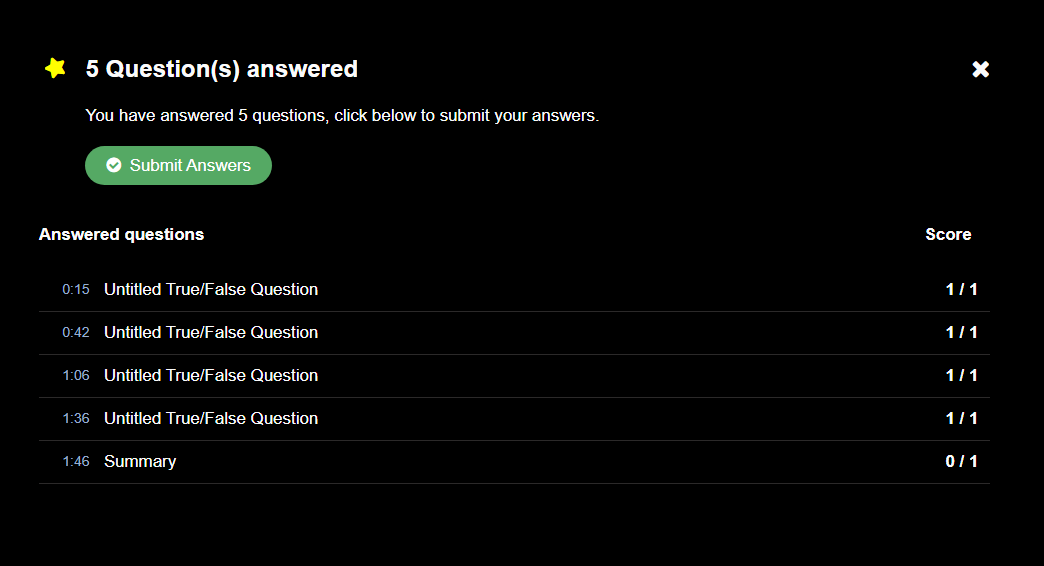
At the end of the video, click on send answers (don't forget to answer the summary question to have 100% of answered questions):
-
EV. 11A. Session 17. Culture Shock Anecdotes H5P
-
WR. 11A. Session 17. Culture Shock in Mexico H5P
This Wrap-up activity is for evaluation. You have before July 22 to do it.
-
-
-
-
-
PR+A. Module 11B. A To-Do List or a Bucket List? H5P
This activity is for Attendance. Get 100% of correct answers.
Read the text. Use a DICTIONARY to learn new vocabulary.

-
EV. Module 11B. My To-Do List and My Bucket List H5P
This activity is for Evaluation. Do it BEFORE July 25.
1. What Is an Infinitive?
An infinitive is the base form of a verb, usually with "to" (e.g., to eat, to travel). It’s used to express goals, desires, or actions that aren’t tied to a specific subject.
2. When to Use "to" (Full Infinitive)
Use "to + verb" after:
Verbs of intention:
She wants to learn Spanish.
They plan to visit Paris.
Adjectives:
It’s easy to forget keys.
I’m happy to help.
Nouns:
He has homework to finish.
Purpose:
I woke up early to catch the bus.
3. When to Use the Bare Infinitive (Without "to")
Skip "to" after:
Modal verbs:
You must drink water. (not "must to drink")
We can go now.
Let/make/help:
Mom let me stay late.
The movie made me cry.
Sense verbs (see, hear, feel):
I saw him dance.
4. Common Mistakes to Avoid
❌ Incorrect: I enjoy to swim.
✅ Correct: I enjoy swimming. (Use gerund after "enjoy")❌ Incorrect: She suggested to eat out.
✅ Correct: She suggested eating out.❌ Incorrect: I need you helping me.
✅ Correct: I need you to help me.5. Practice Tips
Spot the pattern:
Verbs → want, need, decide, hope + to + verb.
Modals → can, should, must + verb (no "to").
Ask: "What’s the action?" → "I want what?" → "I want to sleep."
💡 Example Summary:
"I want to drink tea." (✓)
"She should drink water." (✓)
"He enjoys drinking coffee." (✓ Gerund)
Infinitives help you express dreams, rules, and purpose clearly. Master them to sound more natural in English! 🚀
-
WR. 11B. My Tasks and Goals H5P
-
-
-
-
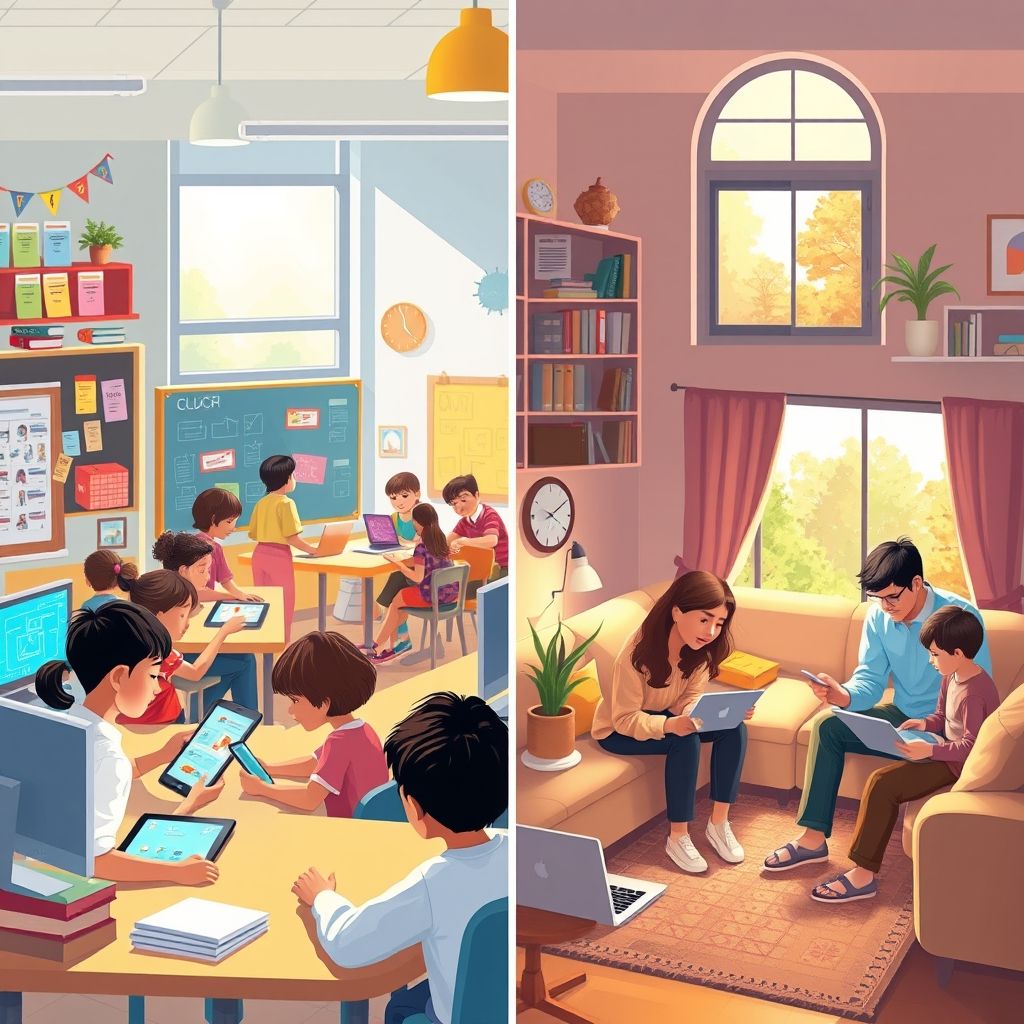
📱 PR+A. Technology in Your Day: Simple & Useful! H5P
-
EV. Module 11C. session 20. Technology. H5P
This activity is for evaluation. Please, do it BEFORE July, Thur. 31.
-
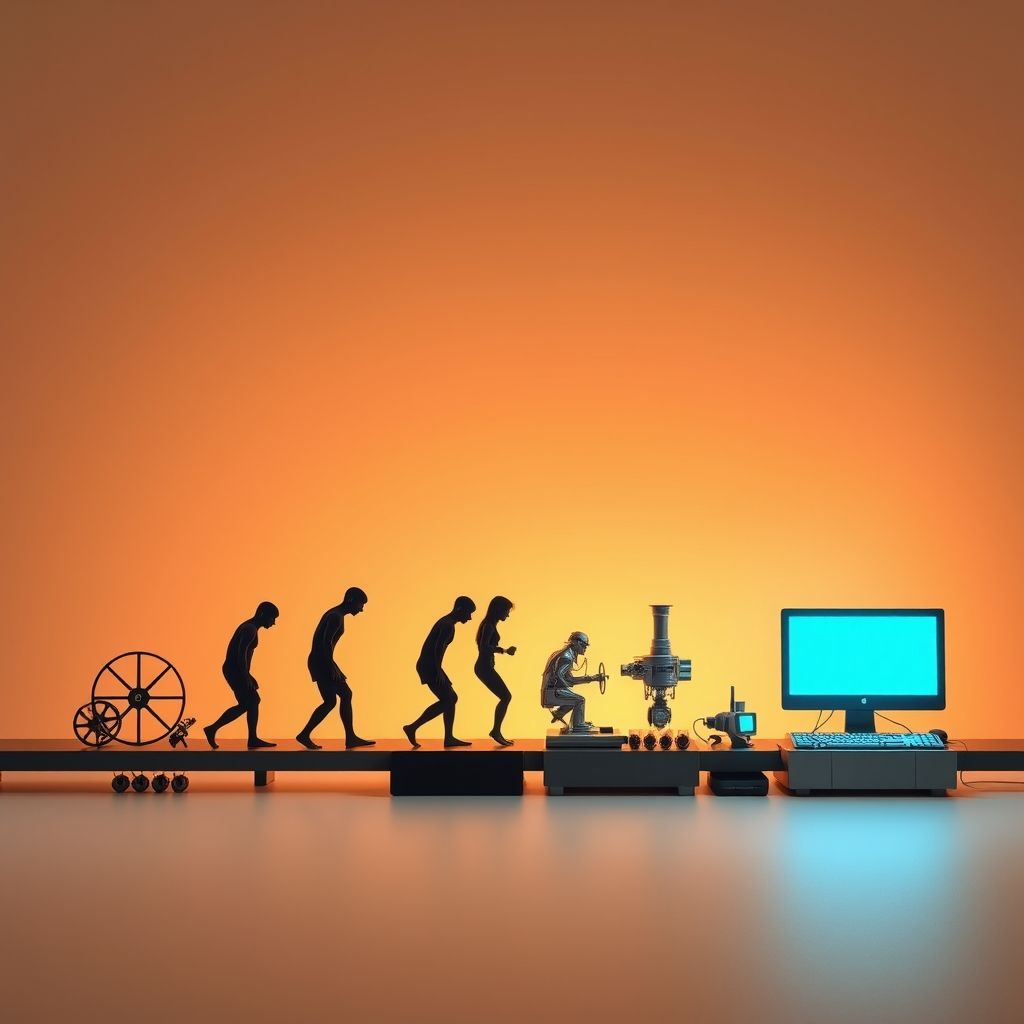
WR. 11C. Session 20. The Evolution of Technology: Changing Our World H5P
This activity is for evaluation. Please, do it BEFORE July, Thur. 31.
-
-
-
Click HERE to see the material.
-
Capitalization Practice. This activity is NOT for attendance nor for evaluation.
-
PR+ A. Modules 11C & 12A. Dictation. 📻 Life Before the Internet: A Simpler Time H5P
This activity is for Attendance. Get 100% percent of correct answers. Do it BEFORE Aug. 2st.
Pay attention to capital letters. Use the activity PR. 📻 Life Before the Internet: A Simpler Time as a reference.
-
-
-
Please, click HERE to watch.
-
-
-
-
Click HERE to watch the material.
Have you been there or Have you gone there? = Did you go and returned or are you still there?
-
This activity is for Attendance. Monday, Aug. 4th and Tue. Aug. 5th.
Get 100% of correct answers.
-
-
-
Opened: Wednesday, 6 August 2025, 7:00 AMClosed: Wednesday, 6 August 2025, 9:00 AM
Your exam is divided into different parts. This is the first part. For this part you have 30 minutes.
Read the texts carefully and answer accordingly.
Para que tu respuesta esté completa, debes escoger si te sientes unsure, not very sure (so-so) or very sure con tu respuesta. Si no marcas alguna de las 3 opciones al final cada una de tus respuestas, NO se te contará como respondida.

You cannot go back to previous questions.
Total of questions: 5.
-
Opened: Wednesday, 6 August 2025, 7:10 AMClosed: Wednesday, 6 August 2025, 9:00 AM
Your exam is divided into different parts. This is the second part. For this part you have 15 minutes.
Read the texts carefully and answer accordingly.
Para que tu respuesta esté completa, debes escoger si te sientes unsure, not very sure (so-so) or very sure con tu respuesta. Si no marcas alguna de las 3 opciones al final cada una de tus respuestas, NO se te contará como respondida.

You cannot go back to previous questions.
Total of questions: 10.
-
Opened: Wednesday, 6 August 2025, 7:20 AMClosed: Wednesday, 6 August 2025, 9:00 AM
Your exam is divided into different parts. This is the third part. For this part you have 20 minutes.
Read the texts carefully and answer accordingly.
Para que tu respuesta esté completa, debes escoger si te sientes unsure, not very sure (so-so) or very sure con tu respuesta. Si no marcas alguna de las 3 opciones al final cada una de tus respuestas, NO se te contará como respondida.

You cannot go back to previous questions.
-
Opened: Wednesday, 6 August 2025, 7:30 AMClosed: Wednesday, 6 August 2025, 9:00 AM
Your exam is divided into different parts. This is the fourth part. For this part you have 20 minutes.
-
Opened: Wednesday, 6 August 2025, 9:00 PMClosed: Friday, 8 August 2025, 11:59 PM
Your exam is divided into different parts. This is the fifth part. For this part you have 15 minutes.
Listen and read the texts carefully and answer accordingly.
Para que tu respuesta esté completa, debes escoger si te sientes unsure, not very sure (so-so) or very sure con tu respuesta. Si no marcas alguna de las 3 opciones al final cada una de tus respuestas, NO se te contará como respondida.
You cannot go back to previous questions.
-
FE. PART 6. SPEAKING H5P
-
-
-
Opened: Monday, 4 August 2025, 11:33 PM
Encuesta de Percepción del Curso de Inglés III (A2)
Estimad@ alumn@,
Gracias por tu participación en este curso de Inglés III. Tu opinión es muy valiosa para ayudarnos a mejorar la calidad de nuestros cursos. Por favor, tómate unos minutos para responder esta encuesta con la mayor sinceridad posible.
Tus respuestas serán analizadas durante el periodo Inter-trimestral para hacer los ajustes necesarios, por lo que sus respuestas no tienen ningún impacto en su calificación, ya que no forma parte de la evaluación. La información recopilada se usará únicamente con fines estadísticos, de investigación, docencia y mejora de recursos de aprendizaje. Al responder esta breve encuesta, estás aceptando que usemos tu retroalimentación exclusivamente para los fines ya mencionados.
Revisa bien tus respuestas antes de dar clic en "Siguiente" en el panel de navegación inferior. Si pasaste a la siguiente sección y quieres regresar, deberás primero responder todas las preguntas de la sección en la que te encuentras.
-