Food you can't count on!
What are Quantifiers? (For Uncountable Nouns)
Imagine you want to talk about "water" or "money." You can't say "one water" or "two moneys" like you say "one apple" or "two apples."
Why? Because water and money are "uncountable nouns." They don't have a plural form. We can't count them as single items.
We count money, but we can't pluralize the NOUN "money". You can't say "one money, two moneys". that's why the NOUN money is not countable.
So, to talk about the amount of these things, we use special words called Quantifiers.
Uncountable Food List
Here's a list of common food items that we typically consider uncountable, meaning we don't usually say "one oil" or "two breads."
-
Rice: 🍚
-
Sugar: ⬜⬜⬜ (Think of loose sugar grains)
-
Salt: 🧂
-
Flour: ☁️ (Like a cloud of powder)
-
Bread: 🍞
-
Pasta: 🍝
-
Meat: 🥩
-
Chicken: 🍗
-
Fish: 🐟
-
Cheese: 🧀
-
Milk: 🥛
-
Water: 💧
-
Juice: 🍹
-
Coffee: ☕
-
Tea: 🍵
-
Oil: 🍾 (A bottle, representing liquid oil)
-
Butter: 🧈
-
Jam: 🍓
-
Honey: 🍯
-
Soup: 🥣
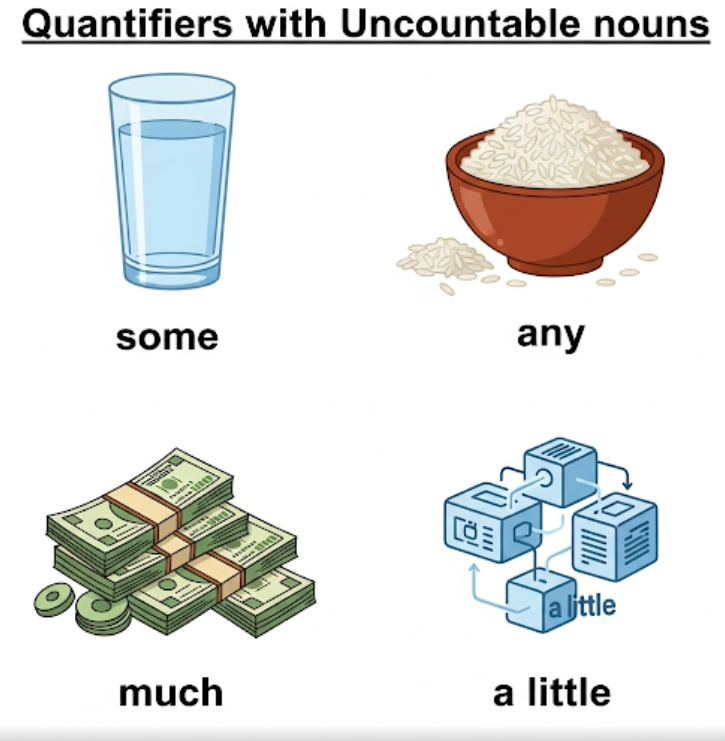
1. Quantifiers
1. "Some" (Positive sentences)
We use "some" when we have an amount, but we don't know or don't say exactly how much.
Rule: Use "some" with uncountable nouns in positive sentences.
Examples:
- I need some water. (Not "I need a water.")
- We have some rice for dinner.
- She likes some music.
- Can I have some information, please?
2. "Any" (Questions and Negative sentences)
We use "any" in questions and when we don't have something (negative sentences).
Rule: Use "any" with uncountable nouns in questions and negative sentences.
Examples (Questions):
- Do you have any milk?
- Is there any money in your bag?
- Do we need any sugar?
Examples (Negative sentences):
- I don't have any time.
- We don't need any advice.
- There isn't any bread.
3. "Much" (Mainly Questions and Negative sentences)
We use "much" when we want to talk about a large quantity. At A1-A2, it's most common in questions and negative sentences.
Rule: Use "much" with uncountable nouns, usually in questions and negative sentences, for large amounts.
Examples (Questions):
- How much money do you have?
- How much water do we need?
Examples (Negative sentences):
- I don't have much time. (Meaning: I have very little time.)
- She doesn't drink much coffee.
Important Note: In positive sentences, we usually say "a lot of" instead of "much" with uncountable nouns. (e.g., "I have a lot of money," not "I have much money.") But for A1-A2, let's keep it simple and focus on "some" for positives.
4. "A little" (Small amount)
We use "a little" when we talk about a small amount of something.
Rule: Use "a little" with uncountable nouns for a small quantity.
Examples:
- Can I have a little sugar in my tea?
- There is a little milk left.
- He has a little experience with computers.
Quick Summary:
- SOME: For positive sentences (e.g., "I have some water.")
- ANY: For questions and negative sentences (e.g., "Do you have any water?" "I don't have any water.")
- MUCH: For questions and negative sentences about large amounts (e.g., "How much water?" "I don't have much water.")
- A LITTLE: For small amounts (e.g., "I have a little water.")
Next Steps: Practice with common uncountable nouns like:
- water, milk, juice, coffee, tea
- rice, bread, pasta, sugar, salt
- money, information, advice, homework, music, time